
What Is Turnitin Used For: Purposes and Use Cases Explained

Many people first encounter Turnitin when submitting coursework, reviewing reports, or managing academic content and wonder what is Turnitin used for in practice.
The platform’s role can feel unclear, especially with mixed claims about plagiarism, originality, and AI detection.
This article explains what Turnitin actually does, who uses it, and why it matters, so you can understand its purpose and decide how it affects your work. Keep reading for clarity.

Core Uses of Turnitin in Academic and Professional Settings
Turnitin is used to check written content for originality, identify matched sources, and support academic integrity in educational and professional settings.
Plagiarism Detection and Originality Checking in Turnitin
At its core, Turnitin analyzes submitted text against a large database of academic publications, student papers, and web content to identify overlapping language.
When people ask Turnitin’s main purpose, this originality check is usually the primary answer. The system produces a similarity report that highlights matched passages and shows where the content appears elsewhere.
For students, this helps catch accidental copying before final submission. For reviewers, it flags areas that need closer inspection rather than making automatic judgments.
Citation Review and Source Matching in Turnitin
Turnitin also helps users see whether quoted or paraphrased material is clearly attributed to a source. The similarity report distinguishes between properly cited matches and uncited overlaps, allowing instructors and students to focus on citation quality.
This use is especially relevant when assignments require strict formatting or source transparency.

A common student takeaway is to review matched sections and confirm that in-text citations and reference lists are complete and consistent.
Writing Integrity Support Using Turnitin Reports
Beyond detection, Turnitin supports writing integrity by encouraging revision and learning. Draft submissions let students review similarity results and adjust wording or citations before deadlines.
Instructors use the same reports to start conversations about academic expectations rather than relying on raw percentages alone.
Turnitin is used to evaluate written content for originality, source overlap, and academic integrity. It helps institutions and individuals identify potential issues before work is graded or published. It also promotes responsible writing practices.

As these core uses show, Turnitin’s role changes depending on who is interacting with the system, which leads directly into a closer look at who uses Turnitin and in what contexts.
Who Uses Turnitin and in What Contexts
Student Use of Turnitin for Submission Review
After understanding the core uses of the platform, it becomes clearer why students interact with Turnitin so frequently.
Students mainly use Turnitin to review their own work before or after submission, focusing on the similarity report to spot overlapping text, missing citations, or formatting issues.
For many, Turnitin’s role at this stage is quality control rather than enforcement.
Draft checks allow students to revise paraphrasing, confirm sources are cited, and reduce unintentional mistakes before final grading.
Educator and Instructor Use of Turnitin for Assessment
Educators use Turnitin as part of the grading and feedback process. Instructors review similarity reports alongside the assignment itself to determine whether matched content reflects proper citation, common phrasing, or potential misconduct.
Turnitin supports consistent evaluation across large classes and helps instructors document concerns when follow-up discussions are needed.
Many instructors also help students understand what is considered a good Turnitin score and how similarity percentages should be interpreted within the context of proper citation and academic writing standards.
Institutional and Organizational Use of Turnitin Systems
At a broader level, universities, colleges, and some organizations deploy Turnitin to support academic integrity policies across departments.
Administrators use aggregated data to monitor trends, ensure consistent standards, and manage submissions at scale. In non-student contexts, such as research or internal training, Turnitin may be used to review written materials before publication.
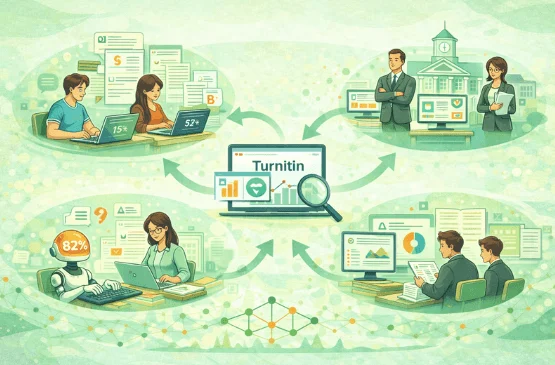
These varied users highlight why understanding the system’s limits is just as important as knowing its audience, which leads into what Turnitin does and does not do.
What Turnitin Does and Does Not Do
How Turnitin Analyzes Text Similarity
After seeing who relies on the platform, it helps to understand how its analysis actually works.
Turnitin compares submitted text against its databases to find matching strings of words and phrases, then displays those matches in a similarity report. This process explains how Turnitin functions at a technical level: identifying overlaps, not judging intent.

The system highlights where text appears elsewhere but leaves interpretation to the reviewer.
Common Misconceptions About Turnitin’s Capabilities
Many of these misunderstandings arise when users are unfamiliar with how to use Turnitin properly and how to interpret similarity reports within their academic context.
A frequent misunderstanding is that Turnitin can automatically determine plagiarism or assign guilt.
In reality, Turnitin does not make decisions or issue penalties. Another misconception is that a high similarity percentage always means misconduct, when it may reflect quotes, references, or common terminology.
Turnitin also does not rewrite content or suggest corrections; it only presents comparison data.
Limits of Turnitin Results and Interpretation
Turnitin results depend heavily on context and user judgment. The system may miss ideas that are paraphrased without proper attribution or flag acceptable matches such as templates and widely used definitions.
Because of these limits, students should review matched sections carefully, and instructors often examine sources before drawing conclusions.
Recognizing these boundaries prepares readers to better understand how similarity scores and reports are meant to be read in practice, which leads into a closer look at understanding Turnitin reports and scores.
Understanding Turnitin Reports and Scores
Similarity Score Meaning in Turnitin
Building on what Turnitin can and cannot do, the similarity score is often the most visible output users focus on.
The score shows the percentage of text that matches sources in Turnitin’s databases, not a measure of wrongdoing. When asking the function of Turnitin here, the score serves as a starting point to locate overlaps.
A lower or higher percentage is not inherently good or bad without reviewing the highlighted matches.
How Instructors and Reviewers Read Turnitin Reports
Instructors and reviewers typically open the full similarity report rather than relying on the percentage alone.
They examine matched passages, check the linked sources, and determine whether the overlap reflects proper citation, common language, or a potential issue.
Many instructors also consider assignment type, draft status, and course guidelines when reading reports. This approach helps ensure evaluations are fair and consistent.
Why Context Matters When Using Turnitin Results
Context shapes how Turnitin results should be interpreted. Quotes, reference lists, and technical terms can raise similarity scores without indicating a problem, while poorly paraphrased ideas may require closer attention even with a modest score.
Students benefit from reviewing reports early and asking instructors how scores are used in their course.
With this understanding in place, common questions about Turnitin naturally follow in the FAQ section.
FAQ

1. What Is Turnitin Used for in Colleges and Universities?
In colleges and universities, Turnitin serves to check text similarity, manage submissions, and support grading and academic integrity processes.
2. Can Turnitin Tell if You Used ChatGPT?
Turnitin does not read intent or writing process; it provides indicators that may prompt review, but instructors must interpret results themselves.
3. What Is Turnitin Used for When Checking Originality Scores?
When checking originality scores, Turnitin’s purpose lies in highlighting matched text and sources so reviewers can assess citation and reuse.
4. What Is Turnitin Used for Compared to Manual Review?
Compared to manual review, Turnitin is designed to speed up comparison and documentation, while final judgments still rely on human evaluation.
5. What Does Turnitin Check for?
Turnitin checks submitted text against its databases to identify overlapping language and matched sources.
Conclusion
This article explored what is turnitin used for by outlining its core purposes, typical users, and how similarity reports and scores are meant to be interpreted.
It showed how Turnitin supports originality review, feedback, and academic integrity while relying on human judgment.
By understanding its functions and limits, readers can approach Turnitin more confidently and use it as a practical tool rather than a source of confusion or assumptions.